The short answer
A single chirp every 40 to 60 seconds most often means a low battery, though patterns vary by brand, and a red flash with no beep is normal on many models. In a hard-wired alarm, the low battery is the backup battery. DFES, WA's fire service, says a beeping or chirping alarm needs maintenance or replacement, so don't ignore it. Check the lights, replace the battery if it's replaceable, and vacuum the vents. If it still beeps, the alarm is probably faulty or past its life, and a hard-wired alarm can only be replaced by a licensed electrical contractor.
Why a smoke alarm beeps or chirps
Start by working out what kind of alarm you have. WA has required hard-wired alarms in new homes since 1997, and before a home is sold, rented or hired since 2009, so many Busselton homes have them. They're connected to the home's wiring, have a green light that stays on while they have mains power, and have a backup battery inside. This is what DFES says each pattern means:
Smoke alarm beeps and lights: what DFES says
| Your alarm | What you notice | What it means | What to do |
|---|---|---|---|
| 9-volt battery alarm | A beep and a red flash together, about once a minute | The battery is low | Replace the 9-volt battery |
| Sealed 10-year lithium alarm | A beep about once a minute, with the red light flashing | The battery is used up | Replace the whole alarm |
| Hard-wired, with a 9-volt backup battery | A beep and a red flash together every 40 to 60 seconds | The backup battery is low | Turn the power off at the meter box, then replace the battery |
| Hard-wired, with a rechargeable lithium backup | A beep every 40 to 60 seconds, with the light flashing | The backup battery is low | After a power cut, it should stop within 2 hours as the battery recharges. If it doesn't and the green light is on, contact the manufacturer |
| Hard-wired, any backup | The green light is off | The alarm isn't getting mains power | Check and reset the circuit breaker. If you're unsure, call a licensed electrician |
| Any alarm | Still beeping after a new battery and a clean | It's likely faulty or at the end of its life | Replace the alarm |
From DFES, WA's fire service, checked 27 September 2026. Patterns vary between brands and models, so check the label on your alarm and its instructions.
A red light blinking on its own, without a beep, is normal on many models. DFES says the red light on a battery alarm should blink every 40 to 60 seconds, and on a hard-wired alarm the green light should stay on.
Brand patterns differ
The same chirp can mean different things on different alarms. One brand uses a flash every 40 seconds to say all is well, while another uses a chirp at a similar interval to warn of a low battery. Check the brand and model on the label, then its instructions. These are the patterns four brands sold in Australia publish:
What manufacturers say their alarms mean
| Brand and model | What you notice | What the maker says |
|---|---|---|
| Brooks, sealed 10-year lithium | A beep about once a minute, with the red light flashing at the same time | Battery depleted: replace the alarm |
| Brooks, hard-wired with a rechargeable backup | A red flash every 40 seconds, green light on | Normal |
| Brooks, hard-wired with a rechargeable backup | Green light off | Mains power failure: check and reset the circuit breaker |
| Brooks, hard-wired with a 9-volt backup | A beep with a red flash once every 40 seconds | Replace the backup battery |
| Clipsal 755PSMA4, hard-wired with a 9-volt backup | A red flash every 40 to 60 seconds, no beep | Normal |
| Clipsal 755PSMA4 | A beep once every minute | Low battery: replace the 9-volt battery |
| Clipsal 755PSMA4 | Red light flashing very quickly, 3 times a second, with no sound | A bad neutral connection or wrong wiring |
| Clipsal 755PSMA4, interconnected | Alarm sounding with its red light off | Another alarm in the house has detected smoke. The one that started it blinks rapidly |
| Red | A chirp every 48 seconds | Low battery |
| Red | The red light flashes twice and it beeps twice, every 48 seconds | A fault |
| Quell | A chirp about once a minute | Weak battery |
| Quell | A red flash every 40 to 45 seconds | Normal |
From each manufacturer's published FAQ or instructions, checked 27 September 2026. The Clipsal patterns are from the 755PSMA4 instruction sheet; other Clipsal models can differ.
A light flashing rapidly with no sound, or a pattern the instructions call a wiring or power fault, is a job for a licensed electrician rather than a new battery.
What you can safely do yourself
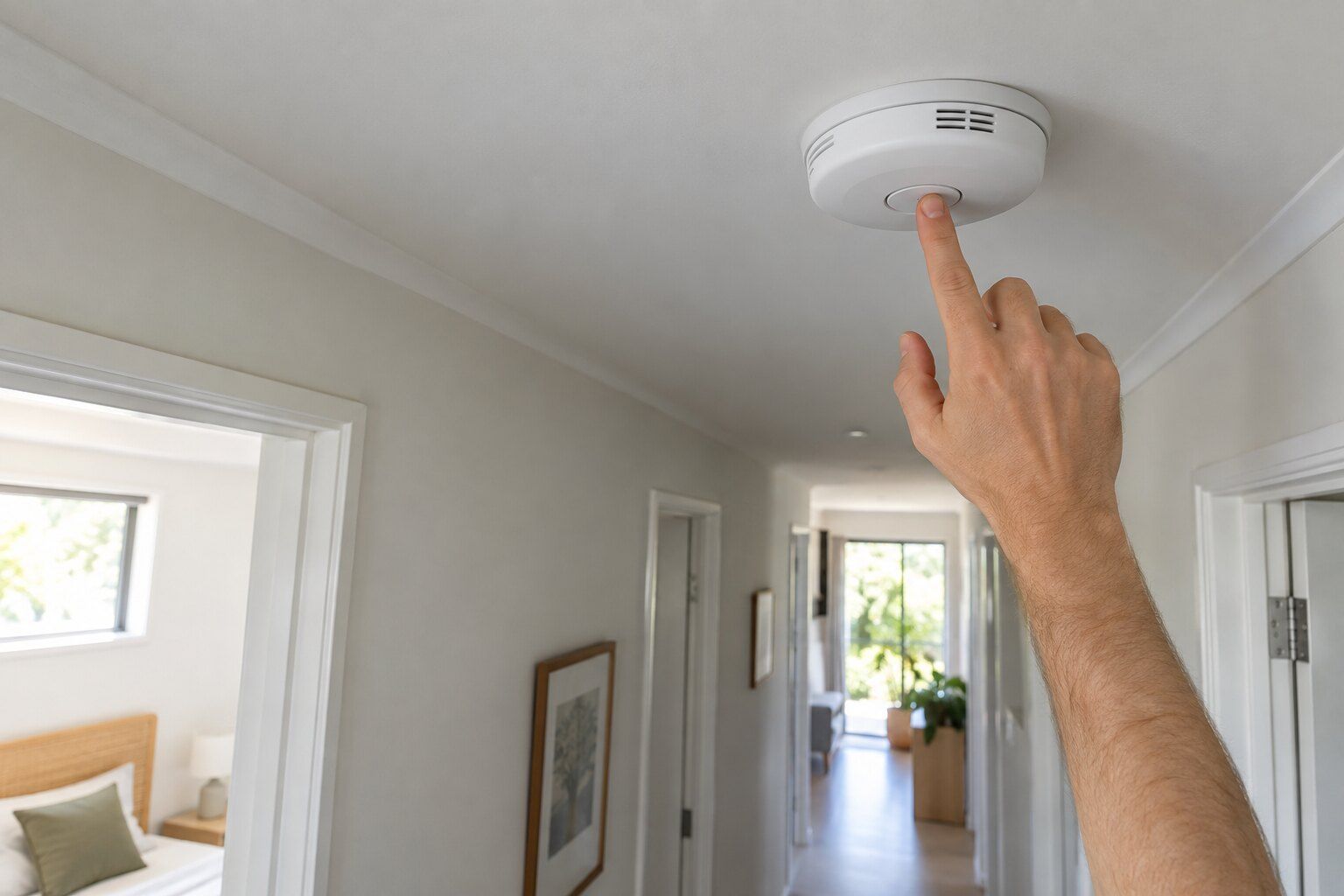
- Press the test button to check it sounds, and the hush button to quieten a nuisance alarm
- Vacuum the vents with a soft brush. DFES recommends doing this every year
- Wipe around the outside with a cloth sprayed with insect repellent, never spraying inside the alarm
- Replace a 9-volt battery every year, and a replaceable backup battery when it's low
Changing the backup battery in a hard-wired alarm
DFES's steps, for alarms with a replaceable backup battery:
- Turn off the mains power at the meter box.
- Take the alarm off its base, following its instructions.
- Replace the battery.
- Put the alarm back, turn the power on and press the test button.
Brooks warns that damaging the battery clip or its wires causes constant beeping. Sealed 10-year alarms don't have a battery you can change: when the battery runs down, the whole alarm is replaced.
What needs a licensed electrician
In WA, only a licensed electrical contractor can connect or disconnect a mains-powered smoke alarm. Taking an alarm off its base to change a battery is fine, but replacing a hard-wired alarm, adding one, moving one or touching its wiring is electrical work. Call an electrician if:
- The alarm keeps beeping after a new battery and a clean
- It's past its replace-by date or more than 10 years old
- The green light stays off after you've checked the circuit breakers
- The instructions say the pattern means a wiring or power fault
- You're selling, renting or letting the home and the alarms need to comply
Alarms installed at the same time reach their 10-year date together, so check the dates on all of them. Interconnected alarms also have to be compatible with each other, so ask the electrician to confirm that.
Full alarms with no fire
A full alarm with no fire is a different problem from a chirp. Building and Energy lists burnt toast, steam from a bathroom and starting a car inside a garage as common triggers. Manufacturers add dust, insects, cooking fumes and high humidity, and Red says early-morning condensation can set alarms off. PSA Products says humidity-related false alarms are most common around 3 to 4 a.m.
On the models we checked, the hush button quietens the alarm for about 10 minutes. On interconnected alarms, every alarm sounds when one detects smoke. On Clipsal's 755PSMA4, the alarm that started it blinks its red light rapidly, which helps you find the one near the toaster. If an alarm keeps going off in the same spot, it may be too close to a kitchen, bathroom or air-conditioning vent. DFES says to keep alarms away from those, at least 300 mm from a light fitting and 400 mm from an air-conditioning vent or ceiling fan blades. Moving a hard-wired alarm is a job for an electrician.
Rentals and holiday homes
In a rental, Consumer Protection WA says the tenant only changes a 9-volt battery where the alarm is easy to reach, and isn't responsible on high ceilings or walls. The landlord has to keep each alarm working, connected to mains power and within its age limit. A home that's sold, rented or offered for hire without a smoke alarm can attract a $1,000 infringement notice, and a landlord or owner who offers such a home for hire could be fined up to $5,000. See smoke alarms and RCDs for the full sale and rental rules.
WA Seniors Card holders may be eligible for a Safety and Security Rebate when buying mains-powered smoke alarms, according to DFES.
Common questions
Why is my smoke alarm beeping every 40 to 60 seconds?
Most often a low battery, though patterns vary by brand. DFES, WA's fire service, says a beep with the indicator light flashing every 40 to 60 seconds means the backup battery in a hard-wired alarm is low, and a beep about once a minute on a battery alarm means its battery is low or used up. If the green light is off as well, the alarm isn't getting mains power.
Why is my smoke alarm beeping after a power cut?
The backup battery ran the alarm while the power was off and is now low. DFES says that once the power is back, the beeping should stop within 2 hours as the battery recharges. If it's still beeping after 2 hours with the green light on, contact the alarm's manufacturer.
I changed the battery and it's still beeping. Why?
Try vacuuming the vents with a soft brush, because DFES says dust and cobwebs can make alarms beep. Brooks also warns that a damaged battery clip or wires cause constant beeps. If it keeps beeping after a new battery and a clean, DFES says the alarm is likely faulty or at the end of its life and needs replacing.
How do I stop my smoke alarm chirping?
Fix the cause: replace the battery if it's replaceable, vacuum the vents, and check the green light and your circuit breakers. On the models we checked, the hush button quietens a nuisance alarm for about 10 minutes, but it doesn't fix the cause. Don't take the battery out or disconnect the alarm to stop the noise.
Can I replace a hard-wired smoke alarm myself?
No. In WA, only a licensed electrical contractor can connect or disconnect a mains-powered smoke alarm. You can change a replaceable backup battery with the power off at the meter box. See smoke alarms and RCDs for the rules on replacing them.
Who changes the smoke alarm battery in a rental?
Consumer Protection WA says the tenant is only responsible for changing a 9-volt battery where the alarm is easily reached, not on high ceilings or walls. The landlord has to keep the alarms working, connected to mains power and within their age limit.
How long do smoke alarms last?
DFES recommends replacing every smoke alarm every 10 years. For a home being sold, rented or hired, WA law requires alarms that are no more than 10 years old and not past their expiry date. Check the date printed on the alarm.
Where this information comes from
The rules and advice on this page come from these published pages, checked on 27 September 2026.
- DFES: smoke alarms · WA fire service guidance on beeping, testing, cleaning and replacing alarms
- Building and Energy: smoke alarms in dwellings for sale, rent or hire · WA Government fact sheet, June 2024
- Building and Energy: smoke alarm laws for homes being sold, rented and hired · WA Government, updated 26 November 2024
- Consumer Protection WA: rental home safety · WA Government guidance for landlords and tenants, updated 13 November 2025
- Brooks: why is my smoke alarm beeping? · Smoke alarm manufacturer's FAQ
- Brooks: how to change an alarm battery · Smoke alarm manufacturer's FAQ
- Clipsal 755PSMA4 smoke alarm instructions · Manufacturer's instruction sheet (Schneider Electric, 2017), hosted by a smoke alarm retailer
- Red and Emerald maintenance and troubleshooting guide · Manufacturer's guide (KPS Australia), December 2024
- Red Smoke Alarms: FAQs · Smoke alarm manufacturer's FAQ
- PSA Products: smoke alarm FAQs · Smoke alarm manufacturer's FAQ
- Quell: troubleshooting · Smoke alarm manufacturer's troubleshooting page